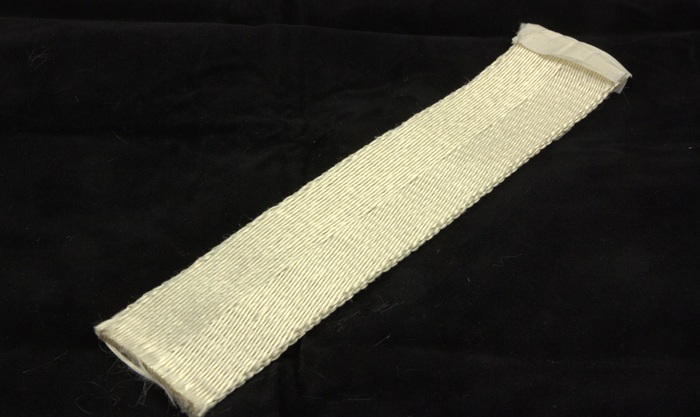
Bally Ribbon Mills (BRM), an industry leader in the design, development, and manufacture of highly specialized engineered woven fabrics, highlights its innovative Vectran webbing product line, which continues to revolutionize safety-critical applications across multiple industries. This high-performance material offers exceptional strength, durability, and resistance to extreme conditions, making it ideal for demanding environments.

Manufactured from liquid crystal polymer, Vectran webbing boasts remarkable properties that set it apart in the market. It features high tensile strength for superior load-bearing capacity, excellent resistance to flex fatigue, chemicals, and extreme temperatures. One of its key characteristics is very low creep, resulting in minimal elongation under stress over time, as well as low elongation and dimensional stability under continuous load.
These characteristics make Vectran webbing particularly well-suited for applications where maintaining structural integrity is crucial. Industries benefiting from this advanced material include PPE protective textiles, inflatables, and tensile structures in both specialty commercial and aerospace sectors.
BRM’s Vectran webbing finds applications in various safety-critical systems, including inflatable systems for aerostats and space habitats, harness and bridle applications for aerospace deceleration systems, safety restraints, and tethers and bridles. The webbing’s ability to maintain structural integrity under prolonged stress makes it essential in applications where failure is not an option. Its durability and minimal stretch properties offer a superior solution for high-performance components.
In a collaboration with Luna Innovations, BRM demonstrated the versatility and advanced capabilities of its Vectran webbing by weaving Luna’s embedded fiber optic sensors into the material. The webbing was subsequently integrated into an inflatable test article that was evaluated at NASA Johnson Space Center, highlighting the potential for Vectran webbing in advanced aerospace applications, particularly in the development of inflatable habitat structures for future space missions.