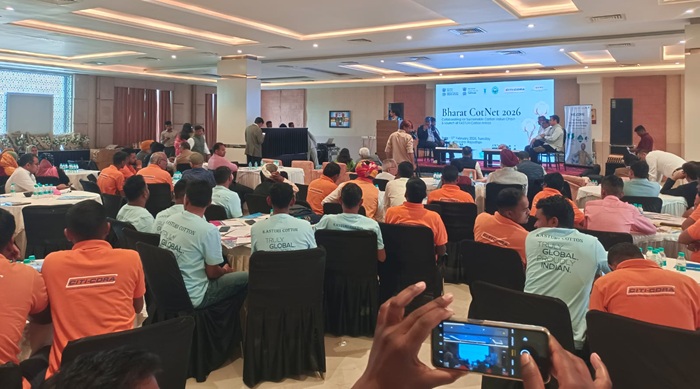
The Confederation of Indian Textile Industry (CITI) and CITI-Cotton Development and Research Association (CITI-CDRA) organized a pivotal conference, ‘Bharat CotNet 2026’, in Bhilwara, Rajasthan, on February 17, to enable stakeholders across the value chain discuss and deliberate on ways to create a robust, resilient, and sustainable cotton ecosystem in the country.

The conference, organized in partnership with TEXPROCIL (The Cotton Textiles Export Promotion Council) and Kasturi Cotton, and supported by the Union Textiles Ministry, the Rajasthan government and Cotton Corporation of India, witnessed the launch of two signature initiatives aimed at boosting premium cotton production with a special focus on ELS varieties:
- Kasturi Cotton Villages
- Kasturi Cotton Mitras
Across the various sessions, speakers – that included Rajasthan Chief Secretary Shri V. Srinivas and Union Textiles Ministry Joint Secretary (Fibre) Ms Padmini Singla – highlighted that when the cotton value chain thrives sustainably, farmers prosper, manufacturers scale responsibly, exporters grow stronger, and India gains more strength in the global textiles and apparel arena.
In keeping with this thought, under the Kasturi Cotton Villages program, select cottongrowing hubs will be “adopted” as model villages. These sites will serve as benchmarks for the Kasturi Cotton Bharat (India’s premium cotton brand) standard, focusing on certified seed adoption, best agronomic and harvesting practices, and complete traceability. The goal is to establish 3–5 model villages per district across India’s cotton belt.
As part of the Kasturi Cotton Mitras initiative, trained field facilitators will be deployed to provide real-time, science-based handholding support to farmers for soil regeneration (using biochar), water management, and judicious fertiliser use, ensuring every harvest meets world-class specifications.
Addressing the conference, Chairman of CITI and CITI-CDRA, Shri Ashwin Chandran, said that the strength of India’s textile industry depends upon the prosperity of the farmer. “When the farmer gains confidence and stability, the entire value chain becomes stronger,” he remarked.
“By identifying villages and empowering trained Mitras, we are creating a system where scientific agronomy, clean picking and contamination-free handling become part of daily farming practices. This will convert Kasturi Cotton from a certification concept into a living ecosystem,” Shri Chandran pointed out.
CITI Deputy Chairman Shri Dinesh Nolkha said the partnership between government institutions and organisations like the CITI-CDRA will be critical to ensuring that the benefits of the Kasturi Cotton Villages and Kasturi Cotton Mitras initiatives reach every cotton-growing village.
“Rajasthan, with its integrated cotton-to-textile ecosystem, offers an ideal starting point. I am confident that the experience gained here will pave the way for replication across other cotton-growing states and further strengthen India’s position in global textile markets,” Shri Nolkha stated.
Rajasthan Chief Secretary Shri V. Srinivas said there was an urgent need to improve the productivity of India’s cotton sector. The Rajasthan government would offer its full support to the Kasturi Cotton Villages and Kasturi Cotton Mitras programs.
Sangam (India) Vice Chairman Dr S.N. Modani and TEXPROCIL Executive Director Dr. Siddhartha Rajagopal also underlined the important role that the Kasturi Cotton Villages and Kasturi Cotton Mitras could play in strengthening India’s cotton ecosystem.
In her introductory remarks, CITI Secretary General Ms Chandrima Chatterjee said the Kasturi Cotton Villages and Kasturi Cotton Mitras were steps towards ensuring that quality begins at the farm itself.