
At this year’s Techtextil in Frankfurt (April 21–24), Barmag will be presenting comprehensive solutions for the production of industrial filament yarns at the VDMA joint stand (Hall 12, C56). The focus will be on applications that ensure greater safety, durability, and efficiency in automotive engineering.

High-performance filament yarns for maximum vehicle safety
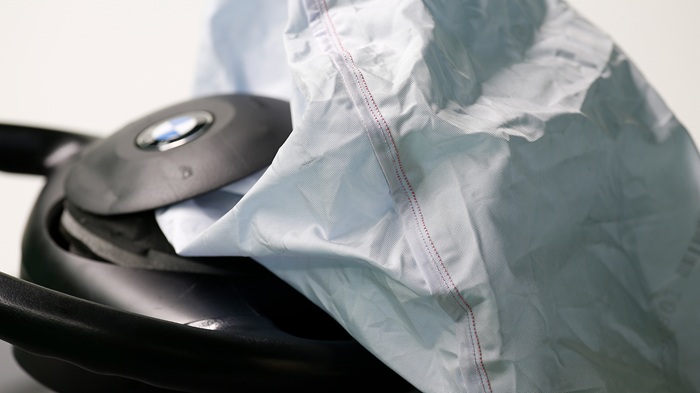
Today’s modern vehicles contain an average of 30 to 35 kilograms of industrial yarns – most of which are used for safety-related components such as airbags and seat belts. Polyamide and, increasingly, polyester filament yarns are predominantly used for airbag applications. Barmag offers particularly energy-efficient and productive technologies for this purpose, enabling stable processes and consistently high yarn quality. “Our solutions meet all the demanding standards for airbag yarns worldwide – throughout the entire service life of a vehicle, regardless of climate or operating conditions,” emphasizes Dr. Jen Supra, Technology Manager for Industrial Yarns at Barmag.
Seat belts: Precision in the high-tenacity yarn process
Seat belts also rely on the performance of industrial filament yarns. A single belt consists of around 300 HT filament yarns, whose high-strength individual filaments can absorb enormous tensile forces of over 3 tons – and at the same time must stretch in a controlled manner in an emergency. Barmag’s patented Single Filament Layer technology enables a gentle, high-precision process for the production of high-tenacity (HT) yarns for maximum safety.
Industrial yarns for stable roads – geotextiles in the substructure
Industrial yarns also prove their performance outside the vehicle, for example in road construction. Geotextiles – such as geogrids under asphalt – require yarns with extremely high titers of up to 24,000 denier. Barmag systems efficiently produce three filament yarns with 6,000 denier each, which can be combined cost-effectively to achieve a higher titer.
Complementing this, the Barmag product brand Neumag supplies spunbond technologies for geotextiles made of polyester or polypropylene, which impress with their high production capacities and low energy consumption.
Neumag’s PP inline technology exceeds the market standard for geotextile applications
In staple fiber production, Barmag is setting new standards for geotextile applications with the Neumag PP inline concept. The improved technology is suitable for strengths higher than 6 cN/dtex with high residual elongation. The fibers thus significantly exceed the parameters previously established in this area of application. The first production plant equipped with the new spinning concept recently went into operation at a well-known staple fiber producer in Asia.
Part of the concept is the EvoDuct air ducting system introduced last year, which ensures more efficient air flow distribution, reduces energy consumption, and improves fiber homogeneity. The optimized EvE-2 monomer and hot air suction system, another Neumag development, minimizes turbulence while increasing spinning performance.