
trinamiX GmbH is expanding its offering for the circular economy sector, enabling the identification of materials from the footwear and textile industries. trinamiX’s mobile near-infrared (NIR) spectroscopy solutions support manufacturers, sorters, recyclers, and brand owners in reliably identifying materials and creating transparency along increasingly complex value chains.

Modern shoes and textiles often consist of complex material combinations and mixed structures, meaning that a purely visual inspection is often insufficient to definitively determine their composition. At the same time, increasing regulatory requirements and sustainability goals are driving the need for traceable and reliable material data.
“Material innovations are driving development in the footwear and textile industries while simultaneously increasing complexity along the value chain,” says Adrian Vogel, Segment Lead Circular Economy at trinamiX. “Our mobile NIR spectroscopy solution offers a practical tool for creating transparency, minimizing risks, and making informed decisions in recycling and circular economy processes.”
Reliable identification of shoe components
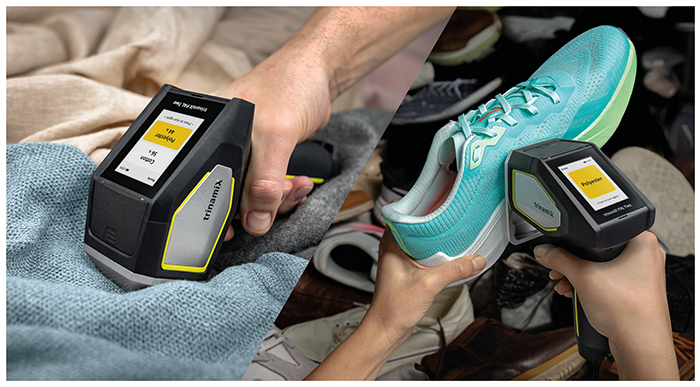
Modern shoes consist of numerous components made from various polymers, foams, textiles, and composite materials. The mobile NIR solution from trinamiX identifies common materials such as EVA, polyester, and PU directly on-site within seconds. Measurements can be taken during incoming goods inspection, production, and sorting or recycling processes. This improves material separation, quality control, and recyclability, reduces contamination risks, and minimizes manual sorting efforts.
Transparency in textile value chains.
In the textile industry, blended fabrics also pose increasing challenges for recycling and reuse. The trinamiX solution supports the identification of relevant textile materials and the analysis of material combinations such as cotton/polyester or viscose/polyester. For two-fiber blends, the fiber content is determined as a percentage. This allows for the reliable analysis and evaluation of complex compositions.
The textile application will be available from May 2026 and is aimed at textile and carpet manufacturers, as well as sorting and recycling companies. It supports them in verifying material declarations, improving sorting accuracy, and implementing closed-loop recycling systems.
Integrated handheld solution for decentralized applications.
trinamiX enables material identification at the touch of a button. The solution consists of a robust mobile NIR spectrometer, a user-friendly app with cloud-based data analysis, and a connected customer portal for exporting measurement data and downloading results reports for traceable documentation. The mobile NIR spectrometer allows for rapid measurements even under demanding operating conditions. The app guides users through the measurement process and delivers immediately understandable results.
Users benefit from consistent results, low training requirements, and standardized material identification across different locations.
The trinamiX ecosystem can also be integrated into existing software solutions and platforms via interfaces (APIs). This supports the further processing of measurement data, particularly in the context of regulatory requirements such as the Digital Product Passport (DPP) and the assessment of sustainability indicators.
Contribution to the circular economy .
Through reliable material identification along the entire value chain, trinamiX’s solution supports companies in implementing circular economy approaches. Improved material transparency contributes to making recycling processes more efficient, reducing downcycling, and increasing the availability of high-quality secondary materials.