
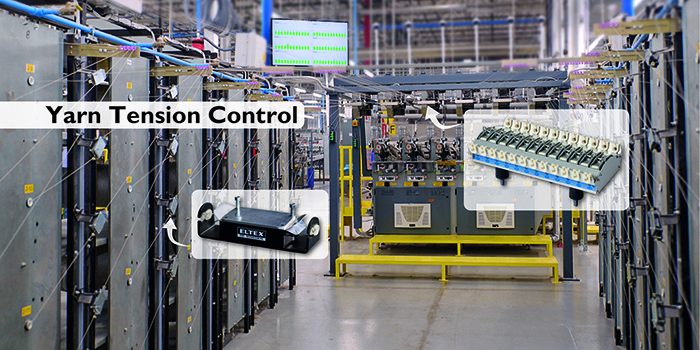
The ACT-MULTI system developed by Eltex – a member of TMAS, the Swedish textile machinery association – is bringing individual yarn tension monitoring and automatic control to the heat-setting process, helping manufacturers maintain consistent processing conditions across every yarn position.

As a critical stage in the production of synthetic and blended yarns, heat-setting relies on precise and consistent processing conditions to stabilise yarn structures, lock in twist and bulk and ensure predictable performance during subsequent processes suchas dyeing and finishing, prior to, or after weaving, knitting or tufting.
This is particularly important in carpet yarn production, where carefully controlled heat treatment relieves internal stresses and improves bulk, resilience, dimensional stability and dye uptake. Variations in yarn tension during the process can consequently have an impact on both processing consistency and the quality of the finished carpet.
The ACT-MULTI addresses this challenge by individually monitoring and automatically controlling yarn tension on the input side of the heat-setting machine tunnel.
Its fast response enables highly precise tension control and the system also incorporates integrated yarn break detection. An external display allows operators to monitor the complete system quickly and clearly, while active yarn positions can be learned rapidly when new orders are introduced.
Tension and stop values can be adjusted independently for each tunnel and sensor parameters configured for different yarn groups, allowing separate settings to be applied to yarns passing through individual tunnels.
“The ACT-MULTI is designed to automatically control the tension of each yarn according to a predefined reference tension,” explains Eltex CEO Brian Hicks. “The system operates independently for each tunnel and also includes a machine stop function in the event of yarn breakage or if yarn tension moves outside the preset stop limits.”
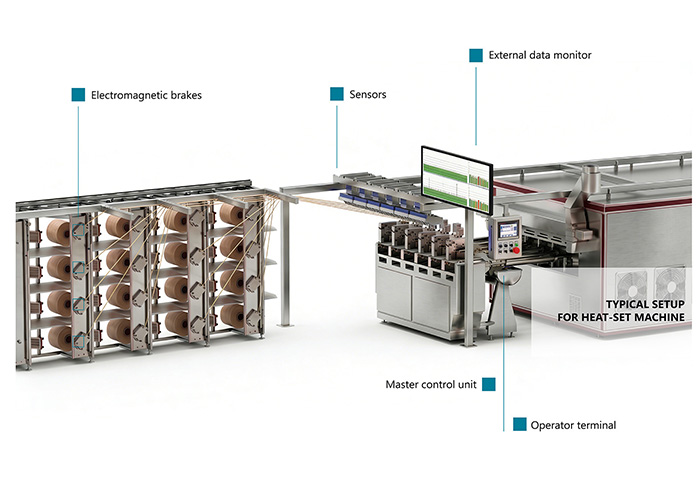
Sensors are available with one, eight, ten or twelve channels, with a LED on each channel indicating the yarn fault position, as well as learned positions and out-of-range conditions.The system monitors all yarns throughout the working process and displays the individual tension of each yarn, with working ranges of 300 or 600 cN.
Designed for straightforward installation and maintenance, the ACT-MULTI also incorporates self-diagnostics and automatic addressing of system components. Modular connections simplify configuration and modification, while the sensors are housed in robust metal casings and the system’s yarn brakes have been designed to minimise maintenance requirements.
“Consistency and control are increasingly important at every stage of textile production, particularly as manufacturers look to reduce waste and avoid quality problems further down the line,” says TMAS secretary general Therese Premler-Andersson. “Eltex has a long track record in yarn tension monitoring and the ACT-MULTI is a good example of how highly focused technology can make an established textile process more reliable, efficient and easier to manage.”