
Home Blog Page 12

Leather pavilion debuts as Fashion SVP Returns to Olympia London

0

FASHION SVP, the UK’s leading fashion sourcing exhibition, returns to Olympia London on 28–29 April 2026. The 19th edition marks an exciting comeback, featuring the debut of the Leather Pavilion, showcasing leatherwear, accessories, and innovative materials from suppliers in the UK, Turkey, Portugal, and the Far East, alongside specialist areas for sustainable fabrics and other materials. The event brings together top manufacturers, designers, and buyers for two days of curated sourcing, networking, and insight.

“Our carefully curated exhibitors help brands build trustworthy relationships,” says Ralph Goodstone, Director of Fashion SVP. “We’re thrilled to launch the Leather Pavilion and showcase other specialist pavilions, giving buyers access to high-quality production and innovative materials from reliable international suppliers.”

The Leather Pavilion responds to the growing demand for specialised, high-quality production, providing buyers with access to a carefully curated selection of international suppliers, ensuring transparency, sustainability, and long-term partnerships.

FASHION SVP 2026 will provide exhibitors with a platform to showcase their expertise while giving buyers direct access to partners for future collections and business growth. Attendees can expect a diverse selection of apparel, accessories, and textiles from major garment-producing regions, emphasising quality, ethical production, and exceptional craftsmanship.

RSWM unveils indigo inspired AW27 denim collection ‘In-DIG’o Alchemy’ at Gartex Texprocess India 2026

RSWM, the flagship company of the LNJ Bhilwara Group, successfully showcased its latest denim innovations at Gartex Texprocess India 2026, held from April 09–11, 2026, at the Bombay Exhibition Centre, Mumbai. At the exhibition, the company unveiled its indigo-inspired, new denim collection ‘In-DIG’o Alchemy – Where chemistry creates character’, for the Autumn/Winter 2027 season.

The collection presented six distinctive categories, Pulse, IndieCraft, Nova-Lab, Aerolite, MetroEdge, and Neo-City, each representing a unique dimension of denim evolution. From essential, everyday constructions and heritage-inspired artisanal expressions to performance-driven innovations, lightweight fluidity, metropolitan versatility, and elevated statement pieces, Indigio captures the diverse and dynamic needs of modern consumers and global fashion ecosystems. Drawing inspiration from the transformative nature of indigo, where colour emerges through reaction, oxidation, and time, the collection reflects LNJ Denim’s own journey of evolution, where science and craftsmanship intersect across fibre selection, fabric engineering, dyeing, and finishing.

Commenting on the successful showcase, Mr. Rajeev Gupta, Joint Managing Director, RSWM Ltd., said, “The response to In-DIG’o Alchemy at Gartex Texprocess India 2026 has been extremely encouraging. Through this collection, we have explored denim across both its most essential and most expressive forms. This collection reflects our continued commitment to combining scientific precision with design innovation to create fabrics that are relevant, responsible, and future-ready.”

Elaborating further, Mr. Ashish Bhatnagar, Deputy Business Head & CMO, LNJ Denim (RSWM Ltd.), added, “Gartex Texprocess India offers a strong opportunity to present our latest unveiling In-DIG’o Alchemy to a diverse set of stakeholders across the value chain. The collection has been well received for its versatility and depth, from everyday core offerings to high-performance and expressive denim solutions. It reflects our focus on building adaptive, forward-looking products aligned with evolving consumer and industry needs.”

Presented to industry stakeholders, designers, and buyers at the event, the AW27 collection positions LNJ Denim as a medium of transformation, where precision, process, and creativity come together to create character. Structured across six distinct yet interconnected categories, the In-DIG’o Alchemy collection captures the full spectrum of denim expression:

  • Pulse – Essential, Redefined: The foundation of the collection, Pulse focuses on core denim constructions that deliver consistency, durability, and everyday wearability. Clean silhouettes, balanced weights, and dependable washes create timeless pieces designed for long-term relevance and cross-market adaptability.
  • IndieCraft – Inspired by Authentic: Rooted in heritage and human touch, IndieCraft celebrates artisanal techniques, vintage washes, and authentic textures. Drawing from traditional dyeing methods and archival aesthetics, it embraces imperfection as a marker of authenticity, reinterpreting legacy denim for the present.
  • Nova-Lab – Contemporary, Urban: Driven by innovation, Nova-Lab reflects the pace of modern urban life through advanced fibres, smart constructions, and performance-driven finishes. It presents denim that is adaptive, technical, and engineered for movement, combining futuristic aesthetics with functional intelligence.
  • Aerolite – Fluid Adaptability: Exploring denim in its lightest and most breathable form, Aerolite introduces softer hand-feel, fluid drape, and lightweight constructions. Designed for comfort and versatility, it enables effortless transitions across seasons while maintaining structural integrity.
  • MetroEdge – Metropolitan Sophistication: Bridging casual and formal, MetroEdge brings precision tailoring, refined finishes, and structured silhouettes to denim. Designed for modern workwear environments, it offers smart versatility with understated elegance and urban polish.
  • Neo-City – Elevated & Expressive: Representing denim’s most transformative stage, Neo-City focuses on statement finishes, experimental washes, and luxurious detailing. It positions denim as an artistic expression, bold, elevated, and visually impactful.

RSWM’s participation at Gartex Texprocess India 2026 reinforces its strategic focus on innovation-led growth and its commitment to strengthening India’s position in the global textile value chain.  The six categories showcased during the event seamlessly move from foundational essentials to elevated fashion statements, reflecting the depth of RSWM’s design, R&D, and manufacturing capabilities, while addressing the evolving requirements of global fashion and apparel ecosystems.

Gartex Texprocess India Mumbai opened today: Innovations driving apparel manufacturing and textile technologies on display

The exhibition comes at a time when India’s textile industry continues to chart a strong growth trajectory, supported by policy initiatives and rising global demands. With textile exports currently valued at nearly USD 36 billion (approx. Rs 3 lakh crore), the Ministry of Textiles has set an ambitious Vision 2030 target of expanding exports to USD 100 billion (approx. Rs 9 lakh crore) by strengthening domestic manufacturing and enhancing India’s global textile footprint. Events such as Gartex Texprocess India incorporating the Denim Show plays an important role in supporting this momentum by enabling technology adoption, industry collaboration and business opportunities across the textile value chain.

The show opened with a ceremonial inauguration attended by distinguished dignitaries and industry leaders, including eminent dignitaries from the industry which included:

  • Guest of Honour: Shri Ajay Pandit, Additional Textile Commissioner, Office of the Textile Commissioner, Ministry of Textiles, Government of India.
  • Mr Sharad Jaipuria, President, Denim Manufacturers Association & Chairman & Managing Director of Ginni International Ltd.
  • Mr Simon Lee, Managing Director of Hyosung Group (Hyosung corporation India Pvt Ltd & Hyosung India Pvt Ltd).
  • Mr Aamir Akhtar, Group President & CEO Textiles, Jindal Worldwide Ltd.
  • Ms. Himani Gulati, Director, MEX Exhibitions Pvt Ltd.
  • Mr Raj Manek, Executive Director & Board Member, Messe Frankfurt Asia Holdings.
  • Mr Winston Pereira, Executive Director, Messe Frankfurt Trade Fairs India Pvt Ltd.
  • Mr Gaurav Juneja, Director, MEX Exhibitions Pvt Ltd.
  • Mr Gagandeep Singh, Secretary General, Denim Manufacturers Association.

India’s textile sector, one of the country’s oldest and most diverse industries, is deeply rooted in centuries-old traditions while continuously evolving through innovation and modern manufacturing. Gartex Texprocess India Mumbai 2026 will witness several new product launches, technology demonstrations and live showcases, providing industry professionals with hands-on experience of garment manufacturing machinery, embroidery machines, laundry and finishing equipment, printing technologies and advanced textile solutions.

The industry stands at a transformative juncture, driven by innovation, policy support and strong global demand. Platforms such as Gartex Texprocess India play a vital role in bringing together technology providers, manufacturers and brands to explore new opportunities and accelerate modernisation across the value chain. With live machinery demonstrations, product launches and focused knowledge exchange, the Mumbai edition offers an important gateway for industry stakeholders to experience the latest advancements shaping the future of garment and textile manufacturing.

The Union Budget 2026–27 has placed the textile sector firmly at the centre of India’s economic growth strategy, recognising it as a key driver of employment, export growth, rural livelihoods and sustainable manufacturing. The sector also possesses significant intrinsic strengths. India is the world’s largest cultivator of cotton by acreage, the largest producer of jute, the second-largest producer of silk and cotton, a major global hub in the man-made fibres (MMF) segment and the second-largest producer of polyester and viscose fibres.

According to the IMARC Group, the India textile manufacturing market reached USD 133.6 billion in 2025 and is projected to grow to USD 192 billion by 2034, registering a CAGR of 3.99%. The growth is being fuelled by government initiatives such as the Production Linked Incentive (PLI) scheme, increasing exports and rising domestic demand for apparel and home textiles. Technological advancements, the growing adoption of synthetic fibres, sustainability-focused production practices and expanding e-commerce channels are also accelerating industry expansion.

Alongside the exhibition, knowledge sessions and industry discussions will provide insights into key topics including technology adoption in garment manufacturing, sustainability in textile production, digital printing innovations, automation in apparel manufacturing and emerging opportunities in denim and fashion supply chains.

With a strong mix of technology, innovation and industry dialogue, Gartex Texprocess India Mumbai 2026 is set to serve as an important platform for collaboration, networking and business development within India’s fast-evolving textile and garment manufacturing ecosystem.

Fashion for Good: Unlocking Post-consumer Feedstocks for Textile-to-Textile Recycling in Europe

Fashion for Good launches Project FAE (Feedstock Activation Europe) to develop the sorting and pre-processing infrastructure needed to channel non-rewearable post-consumer textiles into textile-to-textile (T2T) recycling at scale. The project is a practical response to one of the most pressing problems in textile circularity: making post-consumer waste a viable, commercially competitive raw material for recyclers.

The challenge: a technical and economic gap

When post-consumer textiles are collected, they are first sorted for rewearability and directed to resale markets. What remains (the “non-rewearables”) has few viable destinations today: only a small fraction enters T2T recycling. The majority is downcycled, landfilled, or incinerated. Secondhand export markets, which have historically absorbed significant volumes, are contracting: declining material quality is limiting resellability, while trade restrictions are tightening further. Besides, weak demand in destination countries is leading to excess stock accumulation and, without sufficient recycling or reuse infrastructure to handle it, most of it  often ends up landfilled.

New recycling capacities coming online across Europe could change this, offering a route to valorise a much larger share of non-rewearable textiles. However, that opportunity will only be realised if the upstream feedstock infrastructure is in place to supply them at acceptable cost and quality, which today, is not the case.

The core challenge is feedstock infrastructure (the sorting, pre-processing, and supply systems that sit upstream of recycling) has not yet proven sufficient to meet recycling needs. Post-consumer textiles are heterogeneous and costly to process, and recyclers have stringent specifications of what they can take in, often having different material specifications between different technologies. Sorters see large sections of waste unsellable to recyclers, along with high collection and processing costs for recyclable fractions, while recyclers require competitively priced feedstock. Neither side can close the gap alone: for many sorters preparing material at the price, quantity and quality recyclers need remains challenging, while some recyclers can’t absorb the cost of doing it themselves. That’s why most continue to rely on post-industrial waste, which is often cleaner, more consistent, and easier to process.

The integration of post-consumer feedstock into T2T recycling, however, is a matter of when, not if: demand for recycled fibres is growing, and regulatory pressure is increasing. EU Extended Producer Responsibility legislation will require brands to take financial responsibility for their products at end of life, making functional recycling pathways a commercial necessity.

“We have been talking about textile circularity for years, and the honest truth is that the technology is no longer the bottleneck. What is holding us back is much more unglamorous: the sorting lines, the pre-processing steps, the supply systems that need to exist before a single fibre can be recycled. Project FAE is our attempt to tackle that unglamorous, necessary work head-on – together with the brands, sorters and recyclers who know this problem better than anyone. If we get this right, we unlock something the industry has been trying to reach for a long time.” Katrin Ley Managing Director at Fashion for Good.

Addressing these challenges requires coordinated action across the full value chain: from the brands that put garments into the world, to the sorters that handle them at end of use, to the recyclers that need consistent, quality input materialThe Feedstock Activation Europe (FAE) project, an initiative from Fashion for Good, includes brand partners adidas (the lead sponsor), BESTSELLER, and INDITEX. Strategic partner Rehubs is involved, with Rematters offering on-ground assistance.

The approach: from technical assessment to commercial framework

The project draws on advisory expertise from across the value chain: including sorters such as Boer Group, Circle-8 Textile Ecosystems, Erdotex, Formació i Treball, Humana People to People, Kringwinkel Antwerpen, New Retex, Nouvelles Fibres Textiles, Plaxtil-Essaimons, Sympany, Texaid, and Texlimca; as well as recyclers spread across mechanical, thermomechanical and chemical technologies such as Circ, Circulose, CuRe Technology, eeden, Infinited Fiber Company, Kipas (fibR-e), Matterr, Meltem Kimya, Recover, Reju, OnceMore from Södra, and WornAgain. The project is also supported by ecosystem partners including InvestNL, Landbell Group, Refashion, Reverse Resources, TEXroad, Wargon Innovation, WRAP,ZDHC and Global Fashion Agenda.

“Circularity will not be achieved through product innovation alone. The bigger and more urgent work is building the infrastructure that does not yet exist at the scale we need: sorting, pre-processing, and supply systems that enable post-consumer textile waste to move toward closed-loop recycling. This is not a challenge any single organisation can solve. Project FAE brings together the brands, sorters, and recyclers willing to work together to realize this pathway in the EU, and we are proud to be part of that work” Gudrun Messias; Director, Sustainability Direction at adidas AG

The project works across two parallel tracks:

The first aims to solve feedstock preparation for recycling to unlock the valorisation potential of post-consumer waste, via advanced pre-processes, including fibre blend separation, elastane removal, and contaminant extraction. Project FAE will assess the technological and commercial feasibility of these advanced pre-processing technologies, identifying what is ready to deploy and what still needs development.

The second focuses on infrastructure. Project FAE will develop a framework for regional hubs for large-scale sorting and pre-processing hubs across Europe – facilities that aggregate post-consumer textile volumes, apply automated sorting and mechanical pre-processing, and produce feedstock streams tailored to the specifications of different recyclers. By building at scale and leveraging centralised and automated sorting and pre-processing technologies, the hub model addresses one of the core business model challenges facing sorters today: the cost and complexity of preparing feedstock at the quality and volume recyclers require. At scale, and leveraging automation, it aims to reduce per-unit processing costs, improve feedstock quality, and create a more viable business case for both sorters and recyclers.

Together, the two are intended to produce not just technical findings, but a practical and commercial framework the wider industry can act on, with the ambition to support real implementation in the coming years, as part of broader efforts to build a viable post-consumer waste value chain in Europe.

BASF at Techtextil 2026: Helping to shape the future of the textile industry with tangible solutions

At the leading international trade fair for technical textiles and nonwovens from April 21 to 24, 2026 at the Messe Frankfurt, BASF will present numerous solutions and new projects in the textile sector to customers and partners at booth B 68 in hall 11.0. The focus is on product innovations and future-oriented technologies.

Shoes, climbing ropes and clothing – made with Ultramid Ccycled

Whether outdoor pants, sports shoes or climbing ropes –all showcased items are made with Ultramid Ccycled. BASF offers an innovative mass-balanced product that supports the use of alternative raw materials derived from the chemical recycling of hard-to-recycle plastic waste, such as scrap tires. The recycled raw material is fed into the grid at the beginning of BASF’s production network and assigned to the Ultramid Ccycled products via a mass balance approach. The product quality remains unchanged.

No CO2 in your luggage: Innovative polyamide from BASF in VAUDE’s bike backpack

The TRAILCONTROL ZERO 20+ bike backpack from VAUDE, a leading manufacturer of sustainable outdoor clothing and equipment, sets new standards in collaboration with BASF. For the production of the backpack, VAUDE uses BASF’s innovative Ultramid ZeroPCF, a polyamide 6 (PA6) with a CO2 footprint (PCF) of zero according to a certified cradle-to-gate calculation.

A jumpsuit made from biocircular raw materials

With Ultramid BMB, BASF has developed a sustainable drop-in concept that enables the use of biocircular starting materials in product manufacturing – the result is a jumpsuit from Zara. REDcert²-certified feedstocks replace fossil resources at the very beginning of the production process and are then allocated to Ultramid BMB products via a mass balance approach. Without compromising on quality and performance, the CO₂ footprint (cradle-to-gate) can be reduced by more than 50 % compared to standard Ultramid.

Advanced binder technologies driving durable and more sustainable nonwoven and composite solutions

BASF will also present selected material solutions based on advanced binder technologies for nonwovens and fiber‑reinforced composite materials. Exhibits featuring Acronal and Styrofan binders highlight applications for the construction and automotive industries, including nonwovens made from glass and synthetic fibers. Selected Acronal grades are part of BASF’s bio‑based portfolio and help reduce reliance on fossil resources.
With acForm BASF will present a dispersion-based binder technology for furniture and interior design applications. acForm enables the production of wood fiber mats used as core structures for complex, three-dimensional components with veneer surfaces, offering greater design flexibility than conventional plywood and veneer approaches.
In addition, Acrodur, a low‑emission acrylic resin, is showcased in lightweight composite solutions, including glass filter media for paint booth exhaust air treatment and glass mesh for reinforcement of plaster and insulation systems.

Elastic Microporous Membranes for Waterproof Breathable Applications

BASF and dimpora have jointly advanced the performance of microporous waterproof, breathable membranes. Conventional microporous membranes rely on mechanical stretching to create pores – a process that limits elasticity. BASF’s thermoplastic polyurethane (TPU) Elastollan is combined with dimpora’s technology, to enable a new stretch-capable membrane concept. The result is a truly microporous membrane that provides elastic recovery under functional strain, while maintaining high waterproofness and reliable breathability. It remains PFAS free and solvent free. Because the membrane itself can stretch, it unlocks greater design freedom in textiles, by improving stress distribution, reducing resistance during movement, and supporting complex garment designs.

loopamid – jacket, shirt and tracksuit you can touch

loopamid is BASF’s innovative solution for recycling polyamide 6 (PA 6) textile waste and thus promoting circularity in the fashion industry. The first PA6 made exclusively from textile waste is featured in the Zara jacket launched in 2024, in an adidas tracksuit resulting from the T-Rex project, and in a T-shirt produced together with Fulgar and Pompea.

Outlast launched Bailey – Feel the cool

0

Anyone who picks up the new material from Outlast Technologies GmbH can hardly hide their surprise. The latest product from the temperature specialist feels exceptionally cool to the touch. Launched under the name Bailey, the material immediately makes one thing clear upon first contact: this is more than a conventional textile.

This extraordinary first impression is no coincidence, but the result of a carefully engineered material combination. Bailey combines an exceptionally high heat absorption capacity with a naturally cooling surface. Excess body heat is absorbed instantly, creating a noticeably cool sensation upon contact – an effect that provides immediate relief, especially in warm environments or in applications with direct skin contact.

This experience is made possible by the proven Outlast Temperature Regulation technology in combination with a Lyocell base fabric. Lyocell is known for its smooth surface and natural cool-touch character. In Bailey, this effect is further enhanced by Outlast technology: with very high effusivity, the material delivers an exceptionally fresh and cool sensation on the skin – a sensory experience that surprises and convinces.

At the same time, Bailey offers an outstanding heat storage capacity of 7,500 J/m². This means the material not only cools upon first contact but continues to work proactively. Excess heat is absorbed, stored, and released when needed. Temperature peaks are effectively reduced, sweating is minimized, and a balanced, comfortable microclimate is supported.

In addition to performance, Bailey places strong emphasis on sustainability. The Lyocell fiber is largely derived from renewable resources and requires significantly less water to produce than cotton. The temperature-regulating capsules also contribute environmentally: the wax they contain is sourced from renewable materials, offering a bio-based alternative to fossil resources. Bailey therefore combines tangible comfort with a clear commitment to sustainable materials.

Visually, the material presents a light, clean appearance with a fine, uniform structure. It looks lightweight and premium – already conveying a sense of freshness and purity that is immediately confirmed upon touch.

Bailey is manufactured in Europe and meets the highest environmental and quality standards. Certifications such as OEKO-TEX Standard 100 Class 1 and OEKO-TEX MADE IN GREEN underline its suitability for sensitive applications in direct contact with the skin, as well as a responsible and transparent production process.

Thanks to its material properties, Bailey is suitable for a wide range of applications – from bedding and orthopedic products to linings across various industries, as well as diverse next-to-skin solutions.

With Bailey, Outlast introduces a material that doesn’t need explanation. The extreme, instantly perceptible cooling effect makes the technology immediately tangible – creating a true wow effect, both at the point of sale and in everyday use.

Durak Tekstil to drive innovation at Texprocess 2026 with its functional threads

Developing solutions for dozens of industries ranging from apparel and automotive to footwear, protective clothing, furniture, and mattress, Durak Tekstil will showcase its expertise in functional technical threads at Texprocess 2026.

As one of the leading manufacturers of industrial sewing and embroidery threads, Durak Tekstil will take part in Texprocess 2026, the trade fair for garment and functional textile processing to be held in Frankfurt from April 21–24, presenting solutions developed through its R&D efforts.

Visitors will be able to explore conductive, scented, cut- and flame-resistant, glow-in-the-dark, and reflective threads, along with more, at Durak Tekstil’s booth H30 in Hall 8.0. At the exhibition, the company will not only display its innovative, R&D-driven threads and sample applications, but will also emphasize its position as “a solution partner beyond thread” for the industry.

Yiğit Durak, Vice Chairman of the Board at Durak Tekstil, stated: “Texprocess is one of the key exhibitions we prioritize, both for presenting our products and for engaging with the global market. With its broad and multi-layered visitor profile, the exhibition is followed not only by manufacturers from various industries but also by educational and research institutions. Therefore, we also see Texprocess as a platform to showcase our capabilities. We aim to demonstrate the technical superiority of our threads, all shaped through our R&D efforts, as well as what they can achieve functionally. At the same time, our main goal is for visitors to leave our booth positioning Durak Tekstil not merely as a thread manufacturer, but as a reliable and innovative solution partner on a global scale. We have a very wide product range, and in this context, we aim to engage with decision-makers from a broad spectrum, from sportswear and automotive to mattress, design and occupational safety.”

“At Texprocess, we will not redefine ourselves, we will express ourselves correctly”

Emphasizing that they have developed indispensable products for many different industries, Yiğit Durak noted that despite creating technically strong products, it is not always easy to convey the real benefits these products provide to end users. Durak said: “It is not possible to clearly demonstrate the difference created by the thread, neither in raw bobbin form nor on the finished product. We will increase our efforts to build this awareness among end users. In this context, we have redesigned our product presentation at Texprocess 2026 as a platform where we do not redefine ourselves, but express ourselves correctly. Through the interactive setups we have prepared, we will demonstrate not only the technical features of our threads but also the advantages they offer when used correctly. Visitors will be able to focus more on inspiring applications that can be achieved with our threads at our booth.”

Functionality in textiles begins with Durak threads

Visitors to Texprocess 2026 will be able to discover functional, high-tenacity threads addressing a wide range of applications at the Durak Tekstil booth. Among the threads to be showcased, the following stand out:

Duma – Duraless and Durabobbins threads, Durak SilverPro conductive thread, Durak Redolent scented thread, Durak Fire Safe Aramid threads, Durak Cut Safe thread, UV – WR – AS – ASK and OS threads, glow-in-the-dark embroidery thread Durak Milky Way, reflective Durak Reflective thread, CFR threads, the sustainable Eco thread group, Lyosense and Lyostitch threads, Duracotton Bio thread made from organic cotton, Durak Poly-Strong PC-IR thread providing invisibility against infrared rays, Durak Laser-Safe thread, pest- and insect-repellent Durak Bug Safe thread, cooling-effect embroidery thread, UV color-changing thread, and heat color-changing thread.

With the strength of its well-established history of more than 50 years, Durak Tekstil has achieved significant gains in its export-oriented growth strategy in recent years and continues its efforts to reach its target markets and expand its customer network at Texprocess 2026, taking place from April 21–24.

CMAI’s sixth FAB Show 2026 in Mumbai wraps up successfully with strong buyer footfalls presenting an optimistic sourcing outlook

The 6th edition of the Fabrics, Accessories & Beyond Show (FAB Show), organised by the Clothing Manufacturers Association of India (CMAI), concluded successfully at the Bombay Exhibition Centre, Mumbai, from April 2 to 4, 2026. The show witnessed strong participation from across the textile and apparel value chain, reaffirming its position as India’s leading B2B sourcing platform for the garment industry.  The overall business generated through the show is estimated at around ₹2,600 crores — the highest ever.

Building on the momentum from its inauguration, FAB Show 2026 drew participation from 240 exhibitors and attracted over 14000 trade buyers from more than 350 cities across India, including about 1230 Platinum dealers who were provided roundtrip airfare to source from the show. The event also witnessed overseas buyers from countries like Bangladesh, Sri Lanka, US, UK, Canada, Mexico, UAE, Australia, Ghana, Malaysia, South Korea, Sudan, Somalia, Tanzania and others highlighting India’s growing relevance in global sourcing.

The visitor profile included garment manufacturers, exporters, white label mfrs, sourcing heads, retailers, e-commerce players, agents, distributors, and other key stakeholders, making it a comprehensive marketplace for the Apparel industry. Furthermore, sourcing heads from leading groups like Aditya Birla, Raymond, Zola Fashions, Indoera, Tirupur also visited the show.

Santosh Katariya, President, CMAI, said, “The strong response to FAB Show 2026 reflects the industry’s confidence and reinforces the trade show as a reliable sourcing platform that brings together quality, scale, and innovation. This year’s edition demonstrated how Indian manufacturers and suppliers are adapting to sustainability and technology innovations with agility, offering diverse product ranges and efficient solutions under one roof. Overall, the outlook for the domestic textile and apparel sector remains highly positive. With strong structural drivers in place and increasing alignment between consumer demand and industry capabilities, India is well-positioned to emerge as one of the most dynamic and resilient apparel market”.

Highlighting the broader industry context, Rahul Mehta, Chief Mentor, CMAI, shared, “The Indian textile and apparel industry is witnessing a strong and sustained momentum in the domestic market, driven by robust consumption fundamentals and a rapidly evolving retail landscape. Rising disposable incomes, increasing fashion consciousness, and the expanding middle class are collectively fuelling demand across categories, from value segments to premium and occasion wear. What is particularly encouraging is the deepening of this demand beyond metro cities. Tier II & III markets are emerging as powerful growth engines, supported by the rapid penetration of organised retail and the exponential rise of e-commerce. This has not only democratised access to fashion but also created new opportunities for brands and manufacturers to scale across geographies.”

Sustainability remained a central theme at FAB Show 2026, with a dedicated Pavilion showcasing eco-conscious innovations across textiles, accessories, certifications, and production processes. The pavilion highlighted the industry’s growing focus on responsible manufacturing and the increasing demand for sustainable solutions from both domestic and global markets. Adding to this, Naveen Sainani, Chairman of FAB Show, CMAI, said, “This year’s show reflected the shift towards more responsible and technology-driven manufacturing. From sustainable materials to efficient production solutions, exhibitors showcased how the industry is preparing for long-term growth. Sustainability is fast becoming a key driver of growth in the domestic apparel manufacturing industry. With rising consumer awareness and a clear shift towards responsible fashion choices, manufacturers are increasingly adopting eco-friendly materials, resource-efficient processes, and cleaner production practices. This transition is also building a more resilient and future-ready industry within the domestic market.”

A notable feature of this year’s edition was the integration of technology, with select Artificial Intelligence solution providers presenting advanced tools across design, production, inventory management, and retail operations. The “Future Factory/Green Factories” segment by Magus Fashion City further demonstrated next-generation infrastructure focused on sustainable and efficient manufacturing.

FAB Show 2026 also facilitated curated business networking sessions, enabling focused interactions between brands, exporters, manufacturers, and international buyers. These engagements played a key role in driving meaningful business opportunities and partnerships during the event.

Speaking about their participation at FAB Show 2026, Jignesh Sheta, Director, FABREEN, Surat, said, “We have participated at the CMAI FAB SHOW since its first exhibition. We have always received a good response and we look forward to participating in the upcoming editions. We have seen a continuous flow of customers and a rush at our stall since the opening ceremony and it is very good.”

Ashok Jain, Director, PCJS, PC Jain Textile, Gurgaon, exhibiting at the sustainability pavilion, said, “Everybody is appreciating the concept and they are willing to place some of the orders. And they want to have a business relationship for a longer term. It is my first time at the FAB SHOW. I will rate it out of 10; I can say maybe 8.5 to 9, and people are very cooperative. Each and every person, starting from the registration to the allotment, to taking care and cleaning of the hall, and everything, is very nicely done.”

Darshan Jain, Director, Darshans Design Intelligence, Mumbai, said “At the FAB Show it is our fifth year. We are meeting new people and our existing clients. I would tell all the people of this industry to visit this fair to discover the new developments into fabrics and designs.”

Upcycle Fashion Brand – Bunko Junko, Director – Bhavini Parikh, said, “This is a really great support by CMAI, especially with the sustainability pavilion. We are telling the manufacturers if you have net stock off‑cuts or anything, do reach out to us and we can turn your waste into revenue. I would like to say that the FAB Show is about the quality of turnout. The quality—those who came here, they are really interested in sustainability. So that is really good.”

Spanning nearly 2 lakh sq. ft. of exhibition space, the show featured over 250 exhibitors showcasing a diverse range of fabrics, trims, accessories, machinery, and service solutions. A key highlight of this year’s edition was the debut of the International Pavilion, alongside strong representation from leading domestic textile clusters such as Surat, Ahmedabad, Bhilwara, Jaipur, Ludhiana, Tiruppur, Bengaluru, and Mumbai.

FAB Show continues to serve as a vital platform where industry stakeholders come together to explore new materials, build partnerships, and prepare for upcoming fashion cycles. With a strong emphasis on innovation, sustainability, and efficiency, the 6th edition has further strengthened its role in supporting the growth and transformation of India’s textile and apparel sector.

Results of the 37th ITMF Global Textile Industry Survey

0

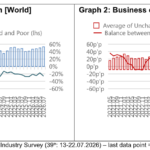
The International Textile Manufacturers Federation (ITMF) released findings from its 37th Global Textile Industry Survey (GTIS), conducted in March sharing how regions and segments are impactedby the latest geopolitical disruptions.

The 37th GTIS shows a deteriorating global business climate, with the global business situation balance falling to -25 percentage points as the US/Israel-Iran war disrupted energy markets. Africa was the only region posting a positive business situation and North & Central America recorded the steepest decline, while garment producers fared best among segments with textile machinery manufacturers remaining deeply negative.

The global business expectations balance collapsed from over +23pp to +5pp – the lowest since November 2022 – as stagflation risks comparable to the post-Ukraine invasion shock of 2022 are reviving. South America led regional optimism while South-East Asia was the most pessimistic. Brands & retailers were the most upbeat segment against a deeply negative outlook for weavers/knitters.

Geopolitics overtakes weak demand as the industry’s top concern

For the first time, geopolitics topped industry concerns at 50%, edging out weak demand at 49%, driven by the war in Iran and surging energy prices, higher raw material costs, and logistics disruptions from the Strait of Hormuz blockade. Notably, tariffs dropped sharply as a concern from 31% to 13%. In response, firms intensify efforts towards market diversification away from the US and internal cost absorption, while relocation of productions and other capital-intensive strategies remain low.

Source – ITMF

AI, Start-ups, Research: Techtextil and Texprocess bring together players in the textile industry

From start-ups to universities and research institutes: at Techtextil and Texprocess, the world’s leading innovation trade fairs in Frankfurt am Main, exhibitors present future-oriented concepts for the global textile industry. With the international Campus & Research area, a strong participation from start-ups and the latest AI applications for textile processing, both trade fairs showcase current developments in the textile industry. By bringing together innovation, research and application, they enable new partnerships across the textile value chain.

Universities, research institutes and start-ups present their visions for the global textile industry at Techtextil and Texprocess – ranging from new materials and smart design tools to automated production chains. “Techtextil and Texprocess bring together global research with textile and user industries. This leads to new ideas and collaborations that bring innovations to the market more quickly,” says Sabine Scharrer, Director Brand Management Technical Textiles & Textile Processing at Messe Frankfurt.

Campus & Research: A global meeting point for textile research

The Campus & Research sector continues to grow and is even more international in 2026: around 40 research institutes and universities from Europe, Asia, Africa and South America share their latest findings with the textile industry here. Participants include Saxion University of Applied Sciences (Netherlands), the InnoFiber Research Lab at the University of Minho (Portugal), IMS Bauhaus Latino América (Uruguay), the Higher Institute of Technological Studies of Ksar Helal (Tunisia) and TU Dresden. The TFI – Institute for Flooring and Interior Systems at RWTH Aachen University demonstrates in a special exhibition how a textile-based guidance system for the visually impaired enables accessibility in indoor spaces. The research institutions and universities are identified by a special sign at the exhibition stand and in the online exhibitor search for visitors.

Start-ups lead the way for the textile industry

About 20 start-ups exhibit their ideas and technologies on the exhibition grounds. At Techtextil, numerous newcomers present innovative approaches to fibres and yarns: the Swiss company Climatex displays circular textile technologies and fully recyclable products, whilst qCella (Switzerland) showcases a cellulose fibre innovation and ultra-thin surface heating technology. R.O.A.M Systems (USA) presents a new type of nonwoven fabric production using additive fibre placement. At Texprocess, the Laboratory for Artificial Intelligence in Design (AiDLab, Hong Kong) demonstrates an AI-supported textile inspection technology for automated textile fault detection and real-time quality control. The Bulgarian start-up Prodactive Solutions showcases, among other things, an AI-supported SaaS platform for production control in the apparel industry. These and other start-ups can be easily found via a sign at their exhibition stands and in the online exhibitor search.

Experience AI innovations first-hand

AI can be experienced first-hand at Techtextil and Texprocess: visitors can interact with two robots at the Style 3D/Assyst booth. The company demonstrates how training software can be used to manage complex processes in apparel production. The Italian exhibitor Willy Italiana presents a checklabel machine that uses self-learning AI to inspect the quality of ribbons and labels. The Spanish exhibitor Picvisa Machine Vision Systems demonstrates how AI-supported optical sorting systems can assist recycling processes by identifying and separating textiles by material or colour. Exhibitors and presentations on the topic of AI can be easily found with the “Texpertise Focus AI” sign.