

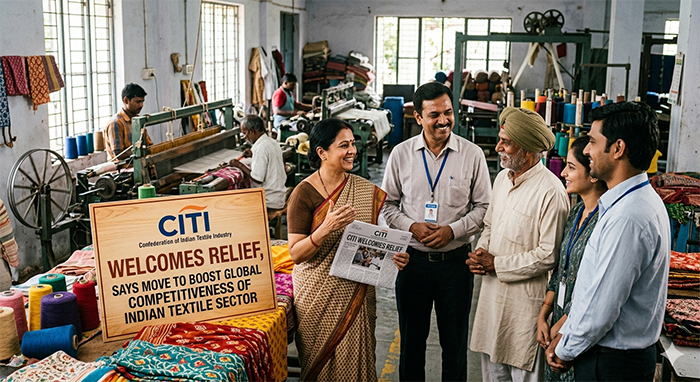
The Confederation of Indian Textile Industry (CITI) warmly welcomes the temporary removal of the 11% import duty on cotton from June 1 to October 31, 2026, for the momentum it can provide to the MSME-dominated Indian textile and apparel sector as it aims to become more globally competitive amid global headwinds.

Along with other industry bodies, CITI had been advocating relief on the cotton import duty. The import duty on cotton was reinstated on January 1, 2026, after a brief hiatus from August to December 2025.
“Amid the ongoing global volatility and uncertainty, the 11% import duty on cotton was acting as a major hindrance to the Indian textile and apparel sector in raising its global competitiveness since our major Asian competitors already have duty-free access to cotton,” CITI Chairman Shri Ashwin Chandran said.
“CITI would like to convey its sincere gratitude to the Hon’ble Prime Minister, the Union Ministers of Finance, Agriculture & Farmers Welfare, Textiles and Commerce, and all concerned officials for this much-needed relief to the Indian textile and apparel arena,” Shri Chandran added.
The CITI Chairman said the cotton import duty was resulting in costs going up across the value chain and having a detrimental impact on scaling India’s textile and apparel exports. India’s textile exports are dominated by cotton. India is aiming for $100 billion in textiles and apparel exports by 2030.
“With this temporary relief in the cotton import duty, India’s textile and apparel exporters can better leverage opportunities that are emerging from the Free Trade Agreements (FTAs),” Shri Chandran pointed out. The FTA with the UK is slated to be operational in a few months from now.
The CITI Chairman said the demand-supply gap arising from steadily decreasing cotton production in India necessitated the need for imports to bridge this gap. “Cotton imports are largely quality and specification-driven, catering to specialised requirements and back-to-back export orders. They do not displace domestic cotton. Also, as a recent joint study by Gherzi and the International Cotton Advisory Committee noted, Indian industry requires a cotton policy environment that will allow us to compete with our Asian peers that have free access to international cotton without any import duty,” he pointed out.
Shri Chandran said the industry’s request for the removal of the cotton import duty was never at the expense of the interests of the farmer.
“For us, it is always industry plus farmer. A thriving textile and apparel industry is the farmer’s strongest customer in keeping with the ‘5F’ vision. Supporting the textile and apparel industry with a more robust policy framework for a critical raw material can ensure long-term gains for both the industry and farmers, in line with the ‘development for all’ principle,” he added.
The textile and apparel sector is India’s second-biggest employer and a major contributor to the GDP and exports. Textile and Apparel Exports declined 2.2 per cent in dollar terms year-on-year in FY26 to $35.79 billion.